 By
By Quantitative research is an important part of the academic and professional world.
No matter if you are a student stuck in writing your thesis or dissertation. A businessman studying market trends. Or maybe a healthcare worker, analyzing their patient’s data. This is something that you don’t wanna miss. It is crucial for your successful journey.
So, just knowing what quantitative research is not enough. But you need to dive deeper and learn the Types of Quantitative Research Methods to perform it successfully.
I know it sometimes becomes hard for researchers to distinguish between the various types. But these techniques help researchers in identifying patterns, measuring facts, and making data-driven decisions. So, no more decision-making based on guesses. But these methods help you make the right decision based on the right data.
That makes the quantitative research method one of the most trusted ways to solve problems and make things right in real life.
Why Quantitative Research Matters?
I know you must be wondering what makes quantitative research so special, right?
Honestly, I would say that it is really special in the world of research as it provides reliable results that are verifiable.
So, quantitative research is all about numbers, measurements, and statistics, too. It basically focuses on collecting data that the researcher can measure or count.
For instance:
- How often does a particular thing happen?
- How many people are using the same product?
- What percentage of students cleared all of their exams?
These kinds of research questions need measurements. Thus, it gives a crystal clear answer as everything is based on the facts that are measurable.
That is exactly why schools, companies, the healthcare sector, and even government agencies rely significantly on quantitative research for better decision-making.
Thus, learning about the different types of Quantitative Research Methods is crucial, especially for newbie researchers. Therefore, the best way is to learn through Quantitative Research Examples.
Always remember, each Quantitative Research Designs serves a specific purpose. Some might help you describe a particular situation. In contrast, others can help you find a relationship between variables. All you need to know is which ones suit you the best. And the only way to know that is to understand the key differences between the various types of quantitative research methods. suit
Don’t worry, you will get to know all of them right here and today.
In this blog, we will learn everything that you need to know about the types of quantitative research methods. So, let us start now.
What Is Quantitative Research?
Before we move forward, I need to make sure that you clearly understand what quantitative research means.
Obviously, you can’t understand its various types unless or until you know what it is really about. So, you need to understand the basics first before going forward.
In simple words, quantitative research is a scientific method that emphasizes on collection of measurable data in the form of numbers or statistics to get the desired results.
Thus, instead of making decisions based on personal opinions or experiences. It is both Experimental and non-experimental. This method relies on facts and statistics for understanding a problem.
So, this technique is most commonly used when the researchers want clear and testable results.
Key Characteristics of Quantitative Research
There are a few key features of quantitative research that make it stand out from the others. So, let’s take a look at them to understand them clearly.
1. Measurable Data
One of the most distinctive features of quantitative research is that it works with measurable data only.
That means, everything that can be counted, measured, or presented in numbers is included here. For instance:
- Exam scores
- Sales figures
- Age, height, or weight of a person
- Frequency of behavior or action
2. Objectivity
The next key feature of this research method is its objectivity. Here, the researcher does not rely on their personal emotions or feelings.
But they have to follow a fixed and long plan to reach fair and verifiable conclusions.
3. Large Sample Sizes
Well, unlike qualitative studies, the quantitative research normally has a large sample size. That means more participants to gather data from.
This helps research to enhance accuracy and minimize any errors.
4. Statistical Analysis
Here, we do the interpretation of data through various statistical tools like SPSS. These tools are quite helpful and help researchers identify various trends or patterns between variables.
Importance of Reliability and Validity
When studying quantitative research, you must know that there are two key terms that it links to:
- Reliability – It implies that the findings remain the same in case the study is replicated. For instance, when you repeat the study on the same group, you should obtain similar results.
- Validity – It refers to the fact that the research measures what it is expected to measure. A study can only be valid when it provides true and meaningful results.
So, these are the two key factors that make the quantitative method one of the most popular ones in the world today.
You know, around two-thirds of research articles published today use the quantitative method, which clearly shows its significance and importance.
Quantitative vs. Qualitative Research
People easily get confuse between qualitative and quantitative research. That is why I have created a quick table to help you understand the key differences in an instant.
| Quantitative Research | Qualitative Research |
|---|---|
| It is based on numbers and statistics | It is based on words, stories, and opinions |
| The sample size is large | The sample size is small and focused |
| Structured questions | Open-ended questions |
| It is Objective | It is subjective |
| Identify patterns and trends with measurable data | Seeks meanings, experiences, and in-depth understanding |
Both of these methods are crucial in the world of research. But the quantitative research method is more preferable when the objective is to measure something. Or you need to compare results between groups.
If you are still confuse about it. You can learn all the details right here (INTERNAL LINK First BLOG) in this insightful blog.
Major Types of Quantitative Research Methods
Now, let us start exploring what we are here for.
Yeah, it is time to reveal the major types of Quantitative Research Methods and understand each one of them clearly. When you start exploring it with me, you will know that each method serves a different purpose.
Some methods will help you define a whole scenario or a situation. While the others can help you compare groups or test relationships. But understanding the difference is the key to making it easier to choose the right method for your study.
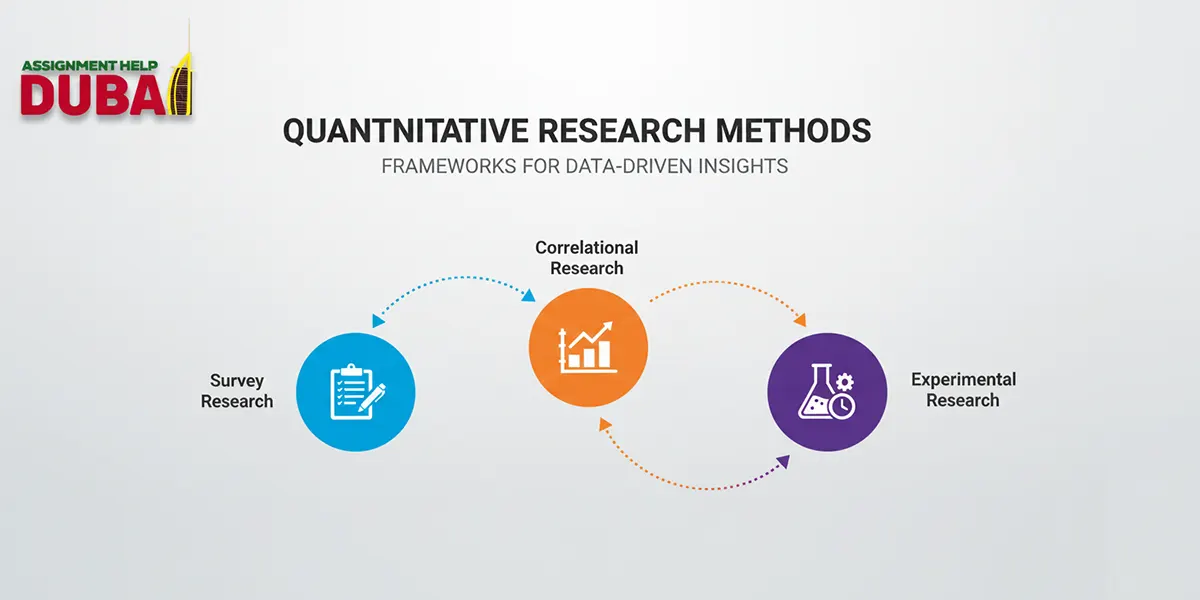
So, here is the list of the five major types of quantitative research methods. Researchers use them in academics and professional research.
Do not worry, they are simple and easy to understand. Let us start now:
1. Descriptive Research
One of the most popular and simplest types of quantitative research is descriptive research. As the name implies, its primary aim is to describe something.
So, it is not here to test any relationships or find them. But it gives you a clear picture of what is happening in a particular scenario or problem.
Purpose
Descriptive research aims at describing the features, behaviours, or trends of a group. It helps you answer questions such as:
- What is happening?
- How much does it happen?
- What are the typical characteristics of this group?
This is handy when a researcher wishes to have a finer picture of a group of people.
Common Methods
The various data collection Methods used in descriptive research include:
- Surveys – Structured questions are included
- Questionnaires – Collecting the answers in a written form.
- Observations – observation and recording behaviors.
These are tools use to enable researchers to collect measurable data. Which can be analyzed later by using descriptive statistics such as percentages, averages, frequencies, among others.
For Example:
A simple example is:
“A satisfaction scale study on university students.”
Here, the researcher is not testing relationships or differences. But they merely want to describe the level of satisfaction among students.
Why Is It useful?
Descriptive research is effective as it is helpful when:
- It offers a clear understanding of the whole scenario
- Assist in building a foundation for future research
- Works great with large sample sizes
- It is really easy to perform and then analyze
So, it is one of the simplest ones.
2. Correlational Research
Correlational research aims to explain the relationship between two or more variables.
It does not attempt to alter or to distort anything. Instead, it looks at natural patterns in order to determine whether quantitative variables are moving in a similar direction.
Purpose
The main purpose of a correlation study is to find out:
- Whether there is a relationship between variables?
- The strength of that relationship and
- The direction of the relationship (whether positive or negative)
Important Rule: It Does NOT Prove Causation
Well, many students just mix up correlation and causation
But let me tell you that correlational studies do not show that one thing causes another. They just demonstrate the relationship between the variables and nothing more.
For example:
“The Students who study more often get higher grades in exams.”
This statement only shows that a relationship exists between study and higher grades. But it does not prove that ONLY studying can lead to this. As other factors might be involved too.
I hope this example is enough to clear things out between causation and correlation in your mind.
Why Correlational Research Is Important?
Learning about the research methods is one thing. But knowing their importance is really crucial. So, let us take a look at why this one is important in research. So, it is essential because it:
- This is an easy method to collect a huge amount of data.
- It highlights key trends and patterns in data.
- Ideal for the preliminary stage of research
- Assist researchers in deciding whether more study is required.
3. Causal-Comparative (Ex Post Facto) Research
Now, the third main type of quantitative Research Methods is causal-comparative research. Also known as ex post facto research.
I know, it sounds scary. But trust me, it is not. In fact, it is all about exploring the cause-and-effect relationships among variables that occur after the event has occurred.
So, the term “Ex Post Facto” basically means “After the Fact.” That means the researcher first studies the effect. Then, they look back and try to understand the possible causes of that effect.
Purpose
The aim is to find out whether a given existing condition can be associated with another. It is applied in cases when experiments are not possible because of some ethical or practical reasons.
Key Characteristics
Let us take a look at some of its key features to understand it clearly:
- No manipulation of variables is involved
- Groups are pre-existing
- Researcher makes comparisons across groups.
- Try to find out the possible causes of an event
Example
Here is an example to make it easy to understand.
“Performing a comparison of test results among students of private and public schools.”
Here, the researcher cannot just decide which participant goes to which type of school. But the groups already exist. Thus, all the researcher needs to do is compare them to get the potential differences.
Why is it useful?
This type of research is quite useful, especially when:
Causal-comparative research is helpful when:
- Variables cannot be manipulated.
- You have to compare natural groups.
- Experiments are blocked by ethical constraints.
- You wish to find the cause-and-effect trends indirectly.
However, just like the correlational studies, this method cannot just define the true causation of an event. As there are too many hidden factors affecting the results already.
4. Experimental Research
When true cause-and-effect relationships are concerned, experimental research is the most powerful and most trustworthy. It is a very common design in science, psychology, education, and medicine.
Purpose
Its primary aim is to find out the presence of any variable that leads to any alterations in another. It requires the manipulation of one variable to see the outcome.
Key Components
The experimental research includes an experiment. Thus, it includes:
- Independent variable – It is changed or controlled by the researcher
- Dependent variable – It is impacted by the change in the other variable
- Control group – does not receive any treatment
- Experimental group – one that gets the treatment or intervention.
- Random assignment – the participants will be randomly assigned to the groups.
Random assignment is highly significant since it limits bias and makes the outcomes more precise.
For Example
Here is an example to show you:
“Trying out the effectiveness of a new teaching approach on the performance of students.”
Now, the process is simple. Students will be randomly split into two groups: One group receives the newer teaching technique. The other carries on with the routine approach.
So, the researcher then compares the performance after a certain period of time. To determine whether the new method made a difference or not.
Why Experimental Research Is Important?
So, it is important because:
- Offers the best evidence for causation
- Results achieved are reliable
- The variables are controlled
- Scientifically, it is well known.
Yet, it is also costly, time-consuming, and not always possible in a real-life scenario.
5. Quasi-Experimental Research
Quasi-experimental research resembles experimental research to a great extent. Except that they do not involve random assignment.
So, this is the main difference. Thus, when the study is initiated, the groups are already established.
Purpose
Well, it has the same goal to test cause-and-effect. But in a more realistic and flexible environment. So, this method is employed by researchers in cases where random assignment cannot be done.
Where is it commonly used?
Quasi-experimental studies are frequently applied in:
- Schools (classrooms) Educational settings.
- Medical facilities (clinics, hospitals).
- Community programs
- Assessment of public policies
So, such settings complicate making it unethical to randomly assign subjects. Thus, researchers operate with groups that are already present.
For Example:
A school might be interested in evaluating the level of performance of students after a new reading program has been introduced. So, the researcher does not randomly assign the students but compares:
- A class that is using the new program, and
- A class that is NOT using the traditional method
The fact that the groups are not made randomly means that the study is quasi-experimental.
Strengths
- It is more practical
- Allows assessment of real-life scenarios
- Applicable in testing community programs.
- Less complex to conduct than experiments.
Limitations
- Uncontrollable external factors.
- Not easy to prove the real causation
- Might have biases in selection
So, these are the major types of quantitative research methods. I am sure that after reading this, you won’t have any problem in choosing the right method for you.
Data Collection in Quantitative Research
It is now time to take a look at how researcher actually collects the data in quantitative research. We have been discussing data collection a lot. The collection of accurate and reliable data is the backbone of all types of quantitative research methods.
Therefore, even an excellent research design will not give meaningful results without good data. Data used in types of quantitative research methods should be measurable and numerical. Hence, the researchers employ structured and systematic instruments.
Common Data Collection Tools
Let us take a look at some of the most common data collection tools used in various types of quantitative research methods.
Structured Surveys
One of the most commonly used tools is surveys. They involve pre-determined questions where answers are determined in advance, i.e., multiple choice or rating scales. The surveys enable a researcher to gain access to a large amount of data in a short period.
Tests and Assessments
In education and psychology, tests are the most common ones. They give measurable knowledge, skills, or abilities scores. These outcomes may then be analyzed statistically.
Numerical Observation
The quantitative research involves observation that emphasises the counting of behaviours or events. An example of this would be the number of students taking part in the classroom discussions or the frequency of a particular occurrence in a workplace.
Digital Instruments and Tools
Using technology, researchers are able to gather numerical data through sensors, applications, online systems, and other digital technologies. Such tools can be particularly applicable to the medical field, engineering, and business analytics.
So, these are the most common tools for data collection in different types of quantitative research methods.
Importance of Sampling
When we talk about data collection, we cannot ignore sampling, especially when we have a huge population. As studying an entire population is sometimes IMPOSSIBLE.
That is why researchers need to select a sample that can represent the whole population. So, here are a few common sampling techniques for different types of quantitative research methods.
- Random sampling – all members have an equal opportunity to be selected.
- Stratified sampling – splits the population into subgroups and then samples.
- Systematic sampling – sampling of a list on a regular pattern.
The selection of the appropriate sampling technique is necessary to minimize bias and enhance the reliability. So, make sure that you are choosing the right technique to do your job.
Ethical Considerations
In quantitative research, ethics play an important role. Therefore, it is crucial for the researcher to:
- Get informed consent from the participants.
- Secure privacy and confidentiality of information.
- Avoid any harm to the participants
- Create reports honestly without any bias
All you need to do is follow these guidelines as a researcher. These rules make the research valid and socially responsible.
So, consider this your checklist before you embark on your research journey.
Advantages and Limitations
Well, in the world of research, you can never say that this particular method is the best of all.
Whether it is qualitative or quantitative, every research has its advantages and disadvantages.
Nothing is perfect. And even if we talk about the Different Types of Quantitative Research Methods, all of them are unique in their own way.
So, quantitative research is definitely one of the most popular research methods in the world today. But it has some limitations too. Thus, let us explore the pros and cons of the quantitative method to understand it in a better way.
Advantages of Quantitative Research
Here are the key benefits of using quantitative research that make it one of a kind:
- Objectivity: Quantitative research uses numbers and statistics to support its results. Thus, the results are less dependent on subjective views and prejudices. This increases the credibility of the findings.
- Scalability: Surveys or digital technologies can be used to study large quantities of participants within a short period of time. This ensures that quantitative research is applicable to large populations, too.
- Precision: Measurable data gives precise information. Researchers are able to give percentages, averages, and correlations that clearly outline trends and patterns.
- Replicability: Since the methods are organized and standardized, the study can be repeated under similar conditions by other researchers. The concept of replicability is important to test out results and construct scientific knowledge.
- Ease of Analysis: Patterns, trends, and relationships are easy to analyze with the help of statistical tools. This will enable the researcher to make informed decisions using data.
So, these are some of the most popular advantages of quantitative research methods that make it one of the best.
Limitations of Quantitative Research
Now, let us flip the coin and check out the other side of the quantitative research methods. I am sure that you must be thinking that it is just perfect. But let me tell you that it has some limitations too that you must know about.
Here you go:
- Lacks Depth: Quantitative research informs you of what is going on, but not why. It fails to include emotions, thoughts, or experiences in a detailed manner.
- Limited Context: Numerals do not always provide a significant context. For example, a survey might indicate low levels of employee satisfaction but fail to provide the causes of the same.
- Less Flexible: The changes are difficult to make once a survey or test is designed. So, researchers should be able to plan their study well beforehand.
- Potential for Misinterpretation: Analysis of statistical results can be misleading at times unless it is done with care. Correlation is not causation, and numbers should always be used appropriately.
So, these are the possible limitations of this approach. And you can witness them in all types of quantitative research methods.
Applications of Quantitative Research
We are almost done with everything now. You clearly know the different types of quantitative research methods. And I am sure that the difference is clear now.
But there is one thing that you still need to know, its application.
Well, quantitative research is common in most disciplines since it offers valuable, quantifiable, and practical information. So, it is useful in academic research and professional research due to its capacity to analyze numbers and patterns. This feature of the quantitative method makes it one of the most common ones.
Thus, let us take a look at some of the most common applications of this method in various fields. So, here is how and why it is used in different fields:
Education
- Assessing student achievement, based on test scores.
- Determining satisfaction with teaching techniques.
- Comparison of attendance, participation, and graduation rates.
Psychology
- Learning behaviour patterns and mental capabilities.
- Measuring stress, anxiety, or other mental variables.
- Correlation between factors of lifestyle and mental well-being.
Healthcare
- Monitoring patient outcomes and treatment effectiveness.
- Determining the level of diseases.
- Assessment of hospital performance or patient satisfaction.
Business and Marketing
- Understanding of customer preferences and purchase patterns.
- Sales trends and market demand analysis.
- Evaluating the effectiveness of marketing programs.
Engineering and Technology
- Assessing system performance and efficiency.
- Quality control and reliability testing.
- Interpretation of experimental, sensor, or simulation data.
This is how the different types of quantitative research methods are used in various fields. The application of this method is not just limited to these fields, but it is quite vast.
Sometimes it is used separately, while sometimes a mix of both methods is used by the researchers to obtain the desired results. But when objectivity is the goal, then the quantitative method is your go-to approach.
Why It Matters?
I know you must be wondering why it matters so much in the research. Well, one of the main reasons is that it offers statistical evidence to the researchers. This evidence helps them in making informed decisions.
So, they don’t have to rely on their intuitions or personal opinions to make decisions. But they have facts in hand to support their decision. Thus, it is a smart move to make. For instance:
Quantitative research provides statistical evidence that helps decision-makers take informed actions. For example:
- Test data can be used to improve teaching practices in schools.
- Businesses have a chance to improve products according to the customer surveys.
- Patient feedback enables hospitals to make adjustments to services.
Thus, in simple words, we can say that the quantitative method has the power to transform raw data into insights. Hence, guiding the people in drafting, planning, and policies that bring improvement.
FAQs About Quantitative Research
Here are some of the most common questions that students often have about the different types of quantitative research methods.
Q. What are the main types of quantitative research?
Ans: The main types of quantitative research methods include descriptive, correlational,causal-comparative (Ex Post Facto), experimental, and quasi-experimental research. Each of them assists you in gathering numerical data, but achieves a different purpose. You must select the right type of research method that suits your research goals and objectives.
Q. Which type is best for beginners?
Ans: Survey research is the easiest to design and carry out by beginners since it is not complicated. It does not require complex arrangements or high-tech tools to gather data via questionnaires or online forms. It also suits a wide range of topics, and that is why it is a convenient place to begin with students or those who are starting their first research. And want to learn about fundamental tendencies and attitudes.
Q. What is the difference between experimental and quasi-experimental research?
Ans: The experimental and quasi-experimental research are two different sides of the same coin. The key difference between the two is that in experimental research, variables are under complete control, i.e., the researcher will randomly assign the individuals to groups. This helps in determining definite cause-and-effect outcomes. On the other hand, quasi-experimental research lacks random assignment. The participants are assigned to groups according to the naturally occurring conditions. And this makes it more practical yet a little less controlled. So, the main difference is the assignment of the participants.
Q. Can quantitative research use interviews?
Ans: Yes, interviews can be applied in quantitative research, but only when questions are designed to provide numerical answers. These interviews are structured in such a way that all the participants are provided with the same questions, whose answer options are a few answer options. This assists in transforming the responses into quantifiable information, which may be compared and statistically analyzed.
Q. How do I choose the right method?
Ans: To choose the right method for research, you must consider your purpose of the research, the nature of the data you are interested in, and the degree of control your research needs. Correlational research is effective in case you are required to measure relationships. Experimental or quasi-experimental methods should be used in case you want to test cause and effect. Descriptive and survey research are ideal for use in the case of general trends. The most appropriate is the one that suits what you are doing and provides the answer to your primary research question.
Conclusion
In a nutshell, the quantitative research method is one of the most popular types of research methods that is used in various fields and disciplines. We have explored the various types of quantitative research methods, including how they work in various disciplines. These are the techniques that one should understand when they want to gather data that is reliable, measurable, and meaningful.
So, to recall the stuff that we have learned through this blog. There are 5 types of quantitative research methods that are used most commonly.
The descriptive research method is applied to explain the characteristics, trends, or patterns within a population. So, it provides answers to questions such as what is taking place and it is usually done through surveys, questionnaires, or observations.
The correlational method establishes relationships between two or more variables. Although it demonstrates the relationship of variables, it is not a demonstration of causation. So, it can be helpful for trend exploration and forecasting.
The next one is Causal-Comparative (Ex Post Facto) Research. It is research where the cause-and-effect relationship is studied after the event has taken place. The researcher compares the pre-existing groups without manipulating the variables. This makes it the best form of research when experimentation cannot be done.
Experimental research is the most rigorous process, and it involves the manipulation of one variable to observe its impact on another.
Finally, the quasi-experimental is like experimental research, but it lacks random assignment. It is feasible in the real world, such as schools, healthcare centers, or community initiatives.
All these methods have their own disadvantages and benefits. So, the selection of the appropriate methodology depends on the purpose of your research, your data requirements, and the resources you have.
By understanding these types, students, professionals, and researchers can design studies that are reliable, valid, and actionable. Choosing the appropriate method ensures that data collection is efficient, analysis is meaningful, and the conclusions drawn are trustworthy.
So, the knowledge of such types enables students, professionals, and researchers to develop reliable, valid, and practical studies.
Thus, once you learn the skills of the quantitative research method, you are in a position to transform the numbers into insights, make good decisions, and make some contributions to the knowledge in your field.
