 By
By Students have to craft a lot of assignments such as theses, dissertations, research papers, research proposals, and case studies etc. In each of them, they have to conduct comprehensive research, as it is the foundation of academic learning, scientific discovery, and informed decision-making. Beyond academics, research is also used to conduct market research, create a business report, etc.
However, if you need to succeed in your research, it depends on the research strategy you choose. Furthermore, many students make the mistake of starting with research without determining how they will investigate a problem. As a result, the assignment has disorganised findings, weak arguments, and unreliable conclusions. Therefore, a research strategy is crucial as it assists researchers in determining what data to collect, how to collect it, and how to analyse it.
There are four major types of research strategies: qualitative research strategy, quantitative research strategy, mixed-method research strategy, and secondary (desk) research strategy. If you want to understand them in detail, you are in the right place.
What is a Research Strategy?
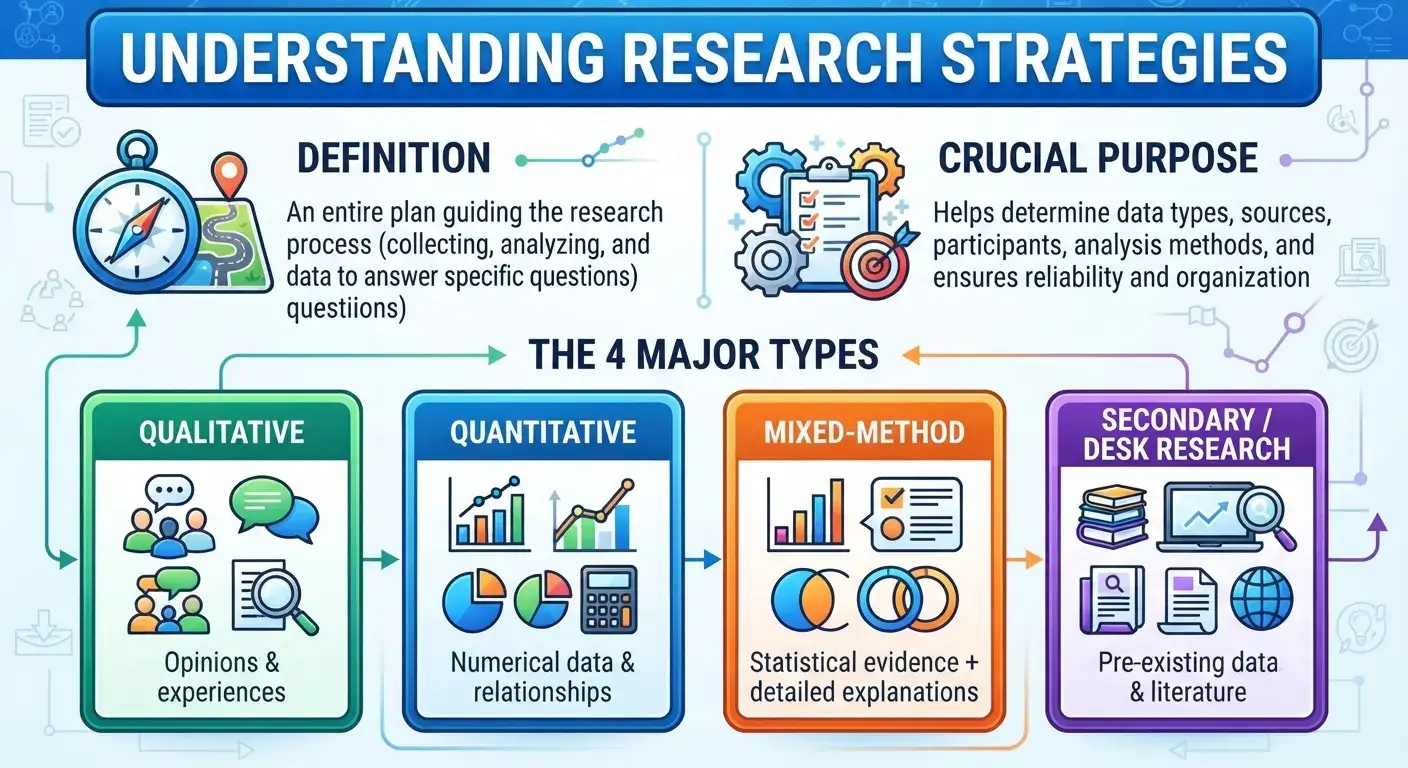
Each type of research strategy has a different objective and is suitable for different types of research questions. For instance:
To explore people’s opinions or experiences, choose a qualitative strategy; to measure the relationship between variables using numerical data, choose a quantitative strategy. Furthermore, if your study requires statistical evidence and detailed explanations, choose a mixed-method strategy.
A research strategy is an entire plan that guides a research process, including how you will collect, analyse, and interpret data to answer a specific question or achieve research objectives.
It connects your research objectives to the practical methods you will use to conduct the study.
The key components of a research strategy include research objectives, methodological approach, research design, and data collection and analysis.
The importance of a research strategy helps a researcher by answering important questions such as what type of data should be collected, where the data will come from, which participants should be involved, how the information should be analysed, and what methods are most suitable for answering the research question.
Choosing the right research strategy is crucial for the reliability and organization of your research.
What are the Different Types of Research Strategies?
Quantitative: Experimental (cause/effect), Correlational (natural links), Survey (questionnaires), Quasi-Experimental (no random assignment).
Qualitative: Ethnography (culture), Case Study (single instance), Phenomenology (lived experiences), Grounded Theory (building new theories), Narrative (personal stories).
Mixed Methods: Convergent (simultaneous), Explanatory (quant first, then qual), Exploratory (qual first, then quant).
Secondary: Literature Review (synthesizing past studies), Archival (examining historical records).
Research strategies are categorized into four types:
Qualitative Research Strategy:
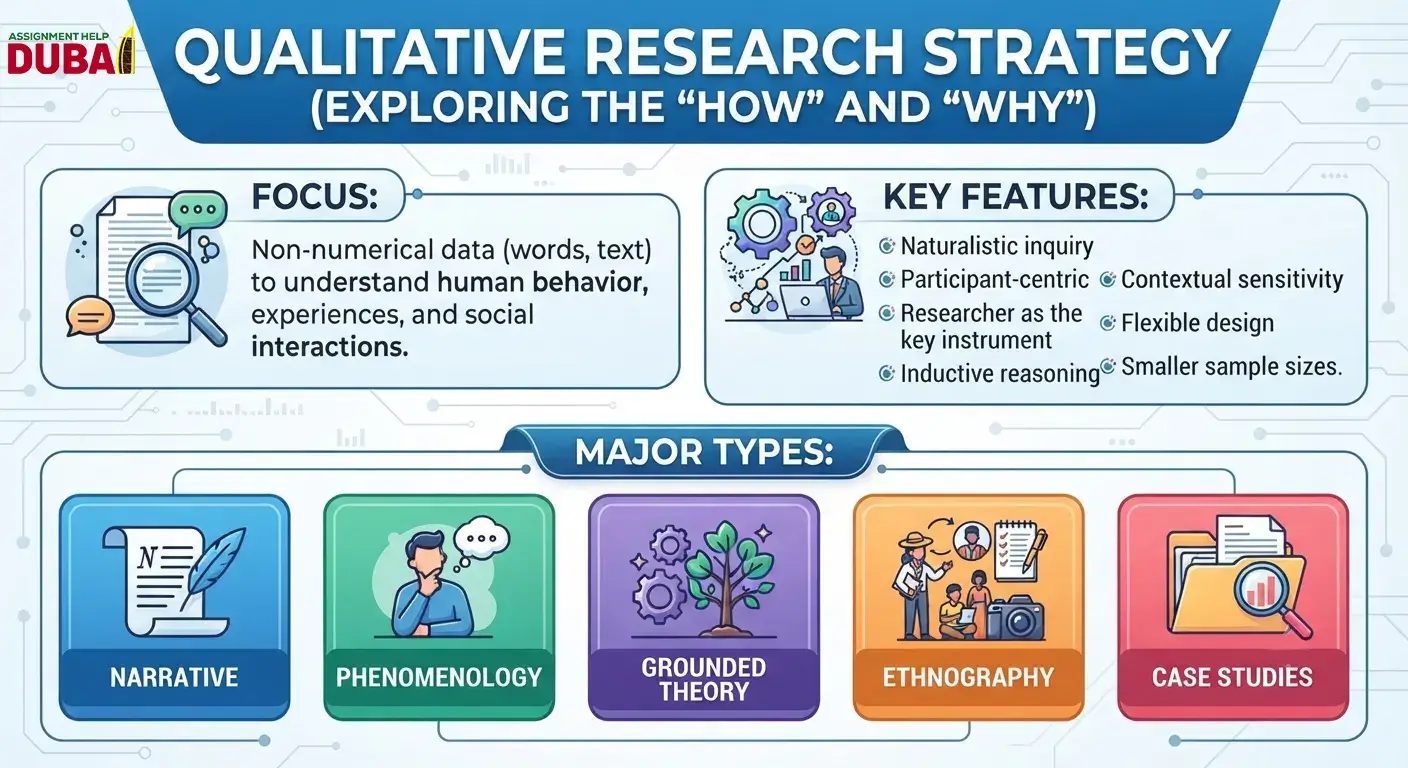
The qualitative research strategy focuses on non-numerical data such as words or text to understand human behavior, experiences, opinions, motivations, and social interactions. Moreover, it deals with the how and why behind experiences and beliefs. Instead of collecting numerical data, qualitative researchers collect primary, first-hand, textual data and analyze it using specific interpretive methods.
This research strategy is suitable when the goal is to explore complex issues instead of measuring them.
What are the Key Features of a Qualitative Research Strategy?
- Naturalistic inquiry: researchers study phenomena in the real world and everyday settings instead of artificial environments.
- Participant-centric approach: this type of research strategy places participants at the centre of its aim to capture viewpoints and lived experiences of the participants themselves.
- The researcher is the key instrument: it is the researcher’s task to collect and analyze the data, relying on their own interpretative skills.
- Inductive reasoning: this research strategy moves from specific observations to broader generalizations, patterns, or theories, rather than testing a predetermined hypothesis.
- Contextual sensitivity: in this type of research, human behavior cannot be placed outside of its specific cultural, environmental, and historical context.
- Flexible design: Qualitative research designs are flexible and evolve as the research progresses.
- Smaller samples: Qualitative research strategy involves smaller, simpler in-depth exploration.
What are the Major Types of Qualitative Research Strategies?
Narrative:
This type of strategy deals with the stories of individuals related to themselves or about the series of events to understand how they make sense of their experiences. The researcher’s task is to collect chronological stories and analyze them to identify recurring themes, patterns and cultural meanings. In this type of research, data is collected through Interviews, diaries, letters, autobiographies, and life histories.
Phenomenology:
This type of research strategy focuses on understanding the lived experience of individuals regarding a specific event or concept. First, researchers have to abandon their perceptions of a certain concept and understand how participants perceive and assign meaning to their experiences. In this type of research strategy, data is collected through open-ended interviews with people who have directly experienced the phenomenon.
Grounded theory:
Grounded theory focuses on deriving theories from the processes, participants’ actions, and interactions that stem from their viewpoint. Researchers use an inductive approach, and data is collected and analyzed simultaneously. Findings continuously shape the ongoing research process until a theory emerges. In this strategy, data is collected through observations, interviews, and document analysis
Ethnography:
The main focus of this research is to study a specific cultural group to understand their behaviors, social interactions, and shared beliefs. In this type of research, researchers immerse themselves in the participants’ natural environment for an extended period. They shift from an outsider to an insider perspective; in this type of research, data is collected through interviews, observations, and field notes.
Case studies:
The main purpose of this type of research is an in-depth and intensive examination of people, processes, events, and programs. The research provides a detailed, contextualized understanding of a real-world subject, often examining the processes and context. In this type of research strategy, data is collected through interviews, documents, and archival records.
What are the Major Qualitative Research Techniques?
| Definition | Suitable for? | Advantages | Limitations | |
|---|---|---|---|---|
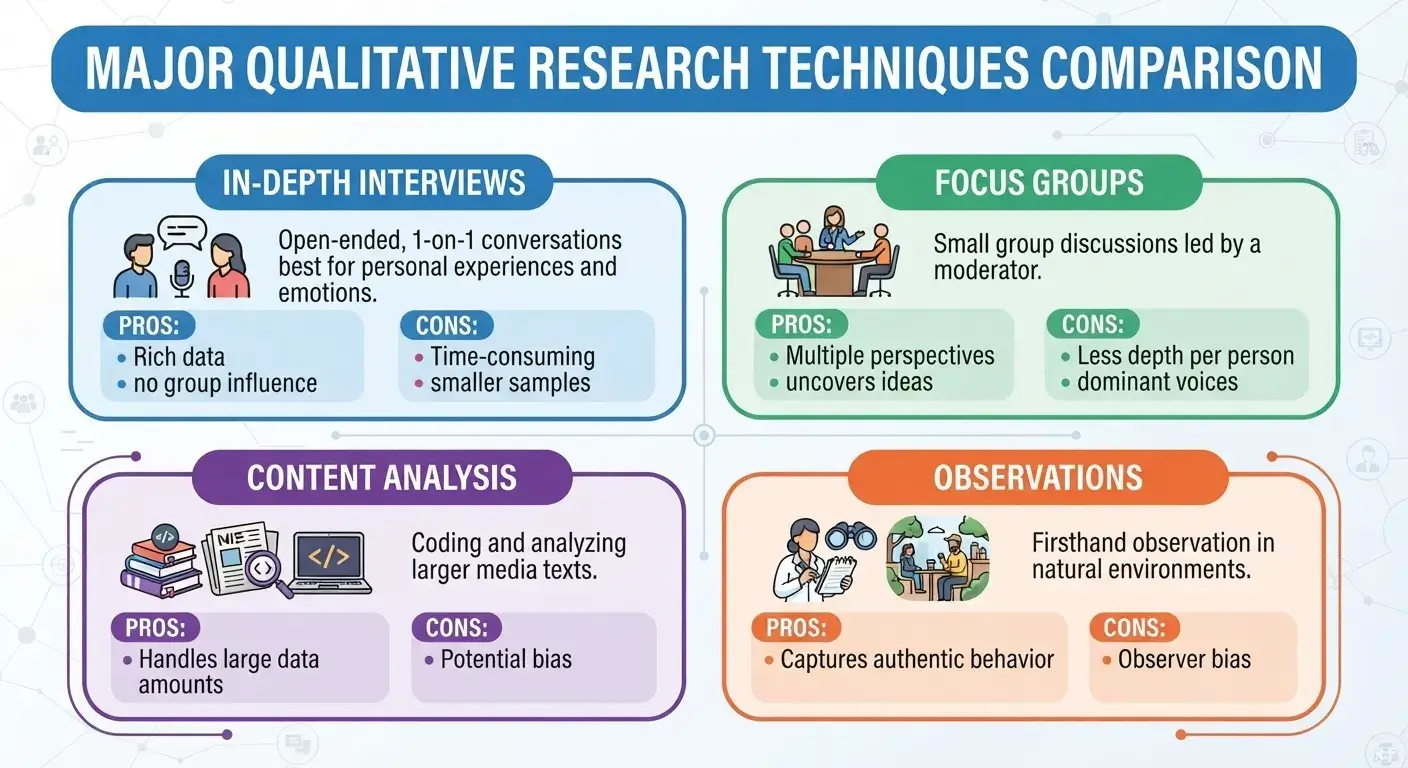
| In-depth interviews | It is open-ended, a one-on-one conversation between a researcher and a single participant. | This technique is best suited for exploring personal experiences, emotions, motivations, and sensitive topics. | It provides rich and detailed data; also, it prevents group influence. | Time-consuming, dependent on the interviewer’s skills, smaller sample sizes. |
| Focus groups | It is a group discussion with a carefully selected small group, and it is led by a moderator. | It is best for rather diverse opinions and group dynamics | It uncovers unaffected ideas, and it is best for collecting multiple perspectives all at once. | Less depth per person, and dominant voices can skew discussion. |
| Content analysis | It involves coding and analyzing larger media texts. | It is best suited for studying communication patterns, | It can handle and analyze large amounts of data. | Bias may be present. |
| observations | It is the firsthand observation of participants in their natural environments to record behaviors, interactions, and settings. | It is best suited to explore real-world practices. | It captures authentic and real-time behavior. | Observer bias |
Quantitative Research Strategy:
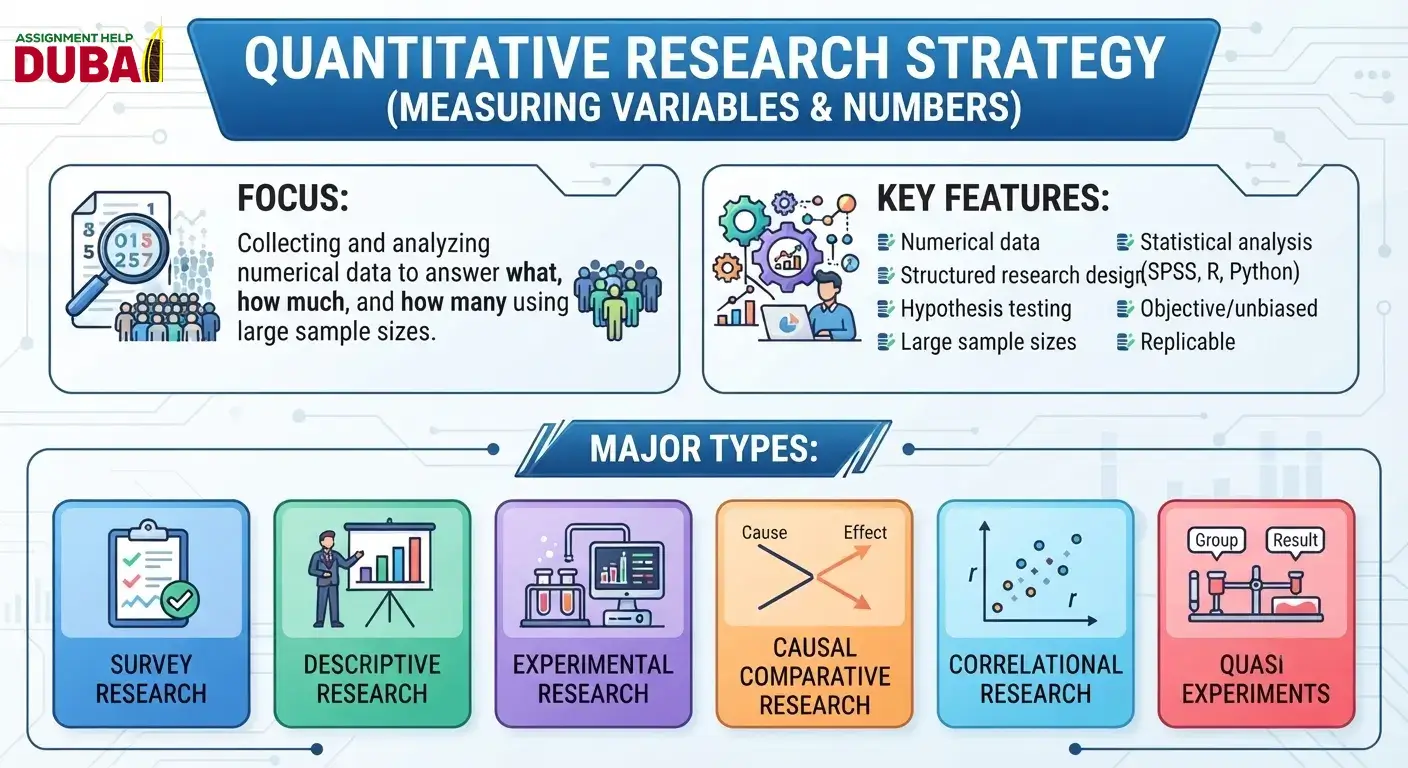
Quantitative research strategy is crucial for collecting and analyzing numerical data. It helps answer what, how much, and how many. It relies on large sample sizes, standardized data collection, and statistical analysis to test hypotheses, identify patterns, and generalise findings across broader populations. Quantitative research strategies offer tools to explore the data with clarity by conducting a survey, running an experiment, or analyzing relationships between variables.
What are the Key Features of a Quantitative Research Strategy?
- Numerical data: in the quantitative research strategy, the information is collected and analyzed as numbers.Counts, percentages, or statistical values.
- Structured research design: data is gathered using fixed and standardised instruments like closed-ended surveys, structured questionnaires, or controlled experiments
- Hypothesis testing: quantitative research typically begins with a clearly formulated hypothesis. The purpose of the study is to test, support, and refute these predictions using statistical evidence.
- Large sample sizes: this strategy uses a large group of people so results represent a whole population.
- Statistical analysis: the data is processed and interpreted using objective mathematical tools such as (e.g., SPSS, R, Python) and inferential statistics
- Objective and unbiased: this type of research is not influenced by the researcher’s personal opinions
- Replicable: it is replicable as the procedures are standardized so the study can be repeated to verify and confirm the findings.
What are the Major Types of Quantitative Research Strategies?
These are the major types of quantitative research:
Survey research:
In this type of quantitative research, the researcher uses standardized questionnaires or structured interviews to collect numerical data related to a specific population’s traits, opinions, behaviors, or trends. The main purpose is to project small-sample findings onto a larger, target population. A good example of this type of research would be distributing an online questionnaire to 1000 consumers to calculate what percentage prefer eco-friendly packaging.
Descriptive research:
It explains events and situations exactly during a current status. However, this research aims to explore the correlation between the phenomena using observations or defining attitudes. The focus of this research is on the what,” “where,” “when,” and “how.”
Experimental research:
It is also known as true experimentation. It is the most rigorous scientific method that establishes cause-and-effect relationships.
Causal comparative research:
This type of research strategy aims to find out cause-and-effect relationships by comparing pre-existing groups. The focus is on comparing two pre-existing groups after a circumstance has already occurred.
Correlational research:
This type of research strategy investigates whether a statistical relationship or association exists between two or more variables. It identifies patterns but does not prove causation.
Quasi-experiments:
This type of research strategy examines cause-and-effect relationships by introducing an intervention or treatment. It relies on naturally formed or intact groups due to ethical constraints.
What are the Major Quantitative Research Techniques?
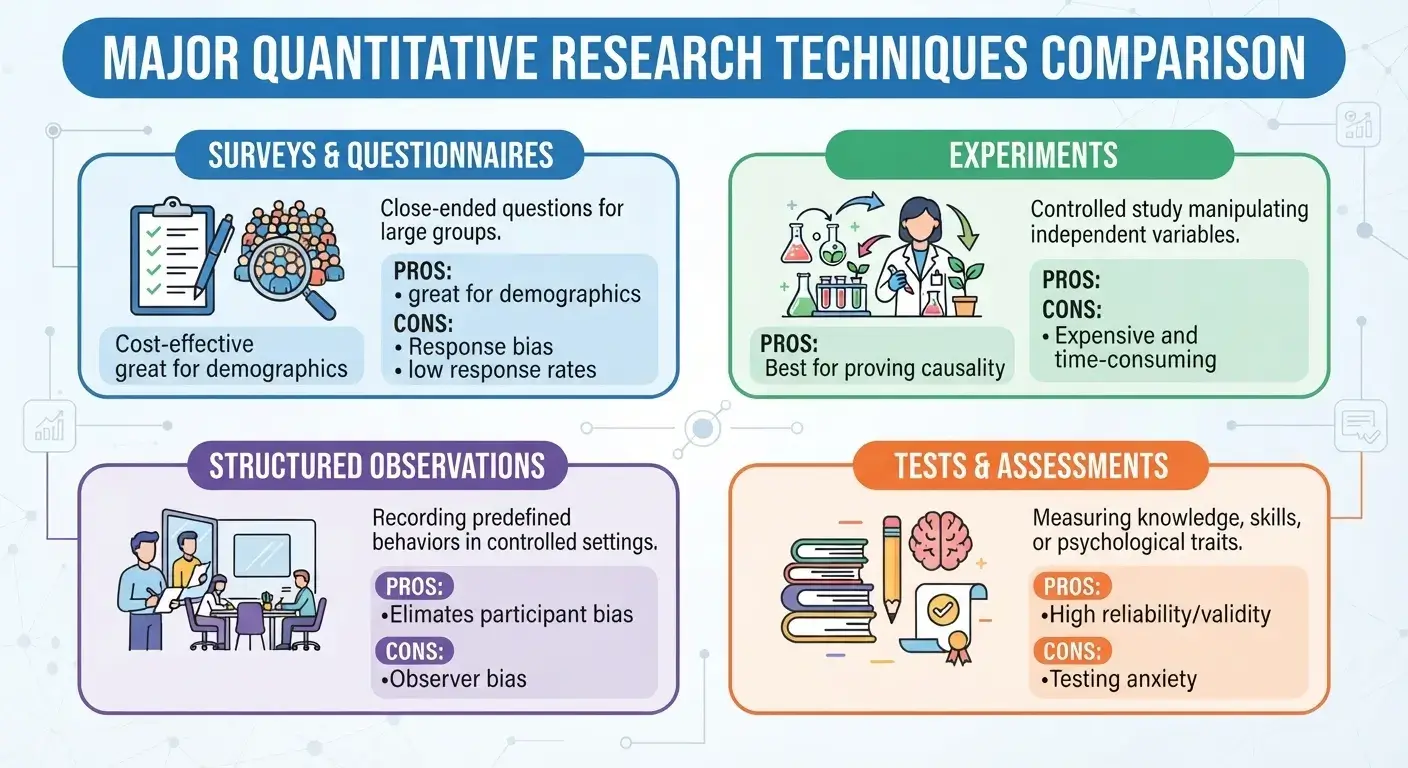
| Definition | Suitable for | Advantages | Limitations | |
|---|---|---|---|---|
| Surveys and questionnaires. | Close-ended questions ( multiple-choice, Likert scales, or yes/no) administered to a large group of people | Large-scale studies, demographic research, market analysis | Conducive to statistical analysis and cost-effective | Response biases and low response rates. |
| Experiments | A controlled study where the researcher manipulates one or more independent variables to observe their effect on a dependent variable, establishing cause-and-effect relationships | Testing specific hypotheses | The best method for proving causality | Expensive and time-consuming |
| Structured observations | Researchers observe and record specific, predefined behaviors in a controlled setting. | Studying physical behaviors | Eliminates participant bias | Observers may introduce bias |
| Tests and assessments | Measures a participant’s knowledge, skills, aptitude, or psychological traits, yielding quantifiable scores or metrics | Evaluating educational programs, psychological research, hiring assessments | High reliability and validity; provides objective scores. | Can create testing anxiety (skewing results). |
Mixed Method Research Strategy:
For a comprehensive view of your research problem, a mixed method research strategy is suitable. This strategy combines both qualitative and quantitative techniques within a single study. When one research strategy is not enough, combining both strategies gives the clarity that you need to make accurate conclusions.
This method is suitable when you need both statistical evidence and in-depth context, you want to validate your findings through triangulation, and when one method may not be enough.
What are the Key Features of a Mixed-Method Research Strategy?
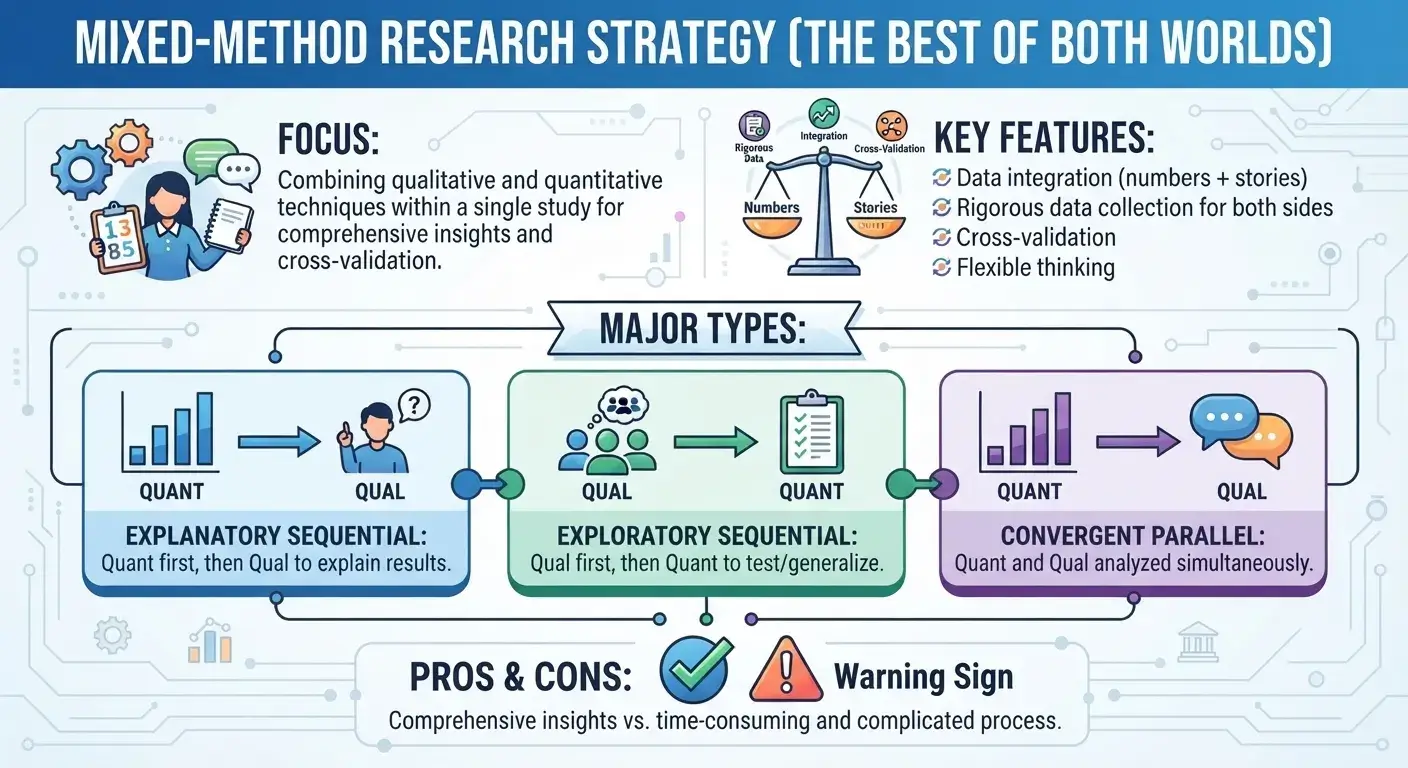
- Data integration: it combines the data with both numbers and stories. This integration can occur during the data collection, data analysis, and even interpretation.
- Rigorous data collection: both quantitative and qualitative data collection must be rigorous on their own.
- Cross-validation: it allows the researchers to validate their findings
- Flexibility: it allows both inductive and deductive thinking.
What are the Major Types of Mixed-Method Research Strategies?
Explanatory Sequential Design
This begins with quantitative data collection and analysis, followed by the qualitative method to explain the quantitative results.
Exploratory Sequential Design:
Starts with gathering and analyzing qualitative data. Then it is followed by quantitative methods to test or generalize initial findings
Convergent Parallel Design:
Quantitative and qualitative data are analysed simultaneously, and then the results are compared and merged for a full picture of the conclusion.
What are the Major Mixed-Method Research Techniques?
Mixed method research strategy combines the techniques of both qualitative and quantitative research strategies.
Advantages of mixed method research strategy:
- Comprehensive insights.
- Addresses the limitations of single methods.
- Validates findings from different data sources.
- Flexible.
Challenges of mixed method research strategy:
- Time-consuming.
- Complicated.
Secondary Research Strategy
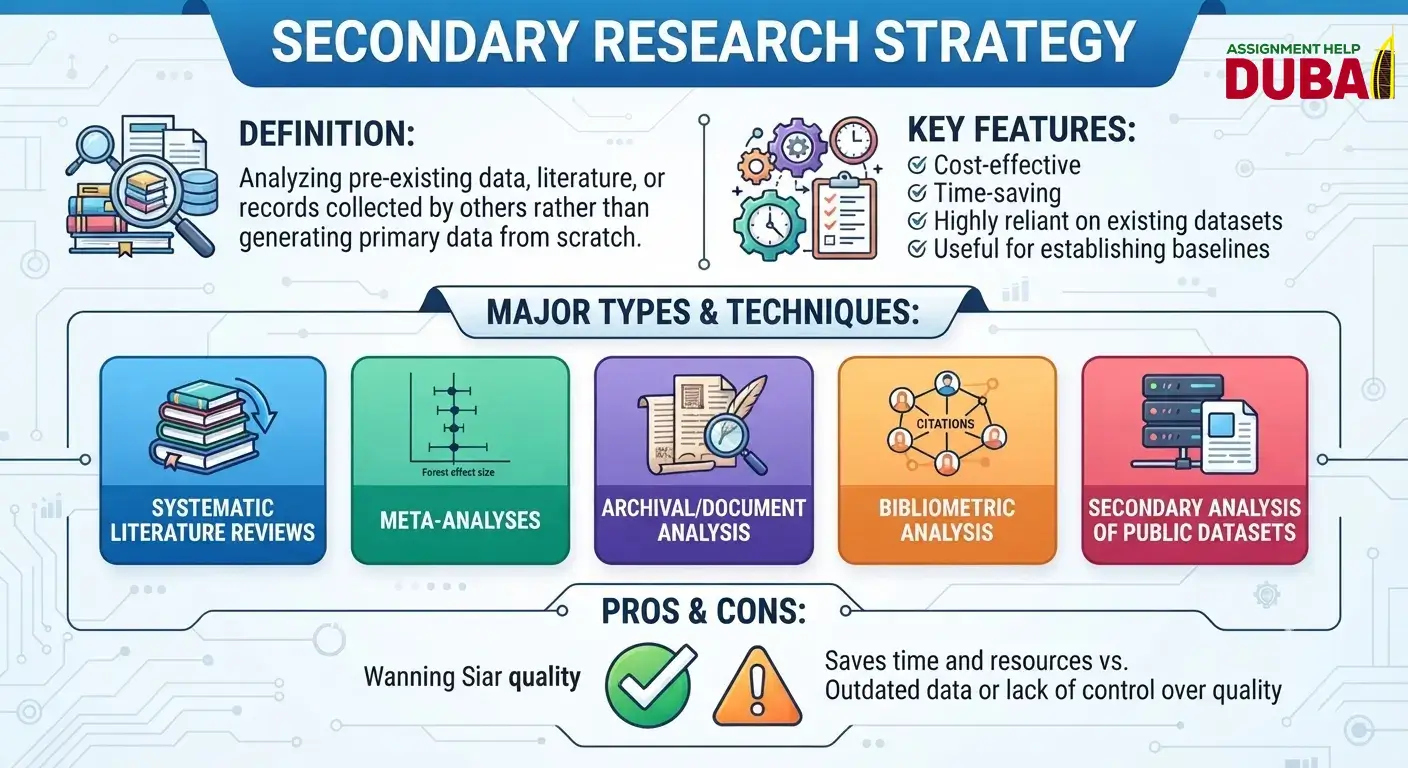
Definition: A research strategy that involves analyzing pre-existing data, literature, or records collected by others rather than generating primary data from scratch.
Key Features: Cost-effective, time-saving, highly reliant on existing literature/datasets, and useful for establishing a baseline or theoretical framework.
Major Types: Systematic literature reviews, meta-analyses, and archival/document analysis.
Major Techniques: Bibliometric analysis, content analysis of historical records, and secondary data analysis of large public datasets.
Advantages: Saves time and resources, provides access to large-scale data, and offers broad historical or contextual perspective.
Limitations: Data may be outdated, lack control over data collection quality, or fail to perfectly match your specific research questions.
How to Choose the Right Research Method?
Choosing the right research method is crucial as it determines the success of your overall research:
- The first step is to decide on your research question so that you can decide on your methodology.
- Then decide on the philosophical orientation.
- Consider the practicality of your research process.
- Consider your field because some fields prefer certain research methods.
All in All!
The different types of research strategies underlie credible research projects. Once you have decided on your research question, consider the strengths and limitations of each strategy and choose the one that aligns with your needs.
FAQs:
What is a research strategy?
A research strategy is a step-by-step guide of the research process, including how you will collect, analyse, and interpret data to answer a specific question.
What are the different types of research strategies?
The different types of research strategies are qualitative, quantitative, mixed method, and secondary research.
What are the advantages of a qualitative research strategy?
A qualitative research strategy provides comprehensive insights, is flexible and adaptable, and generates new hypotheses.
What are the advantages of quantitative research strategies?
The advantages of a quantitative research strategy are that it is objective, adaptable, and reliable.
What is a mixed-method research strategy?
A mixed-method research strategy combines quantitative (numerical) and qualitative (non-numerical) data within a single study.
